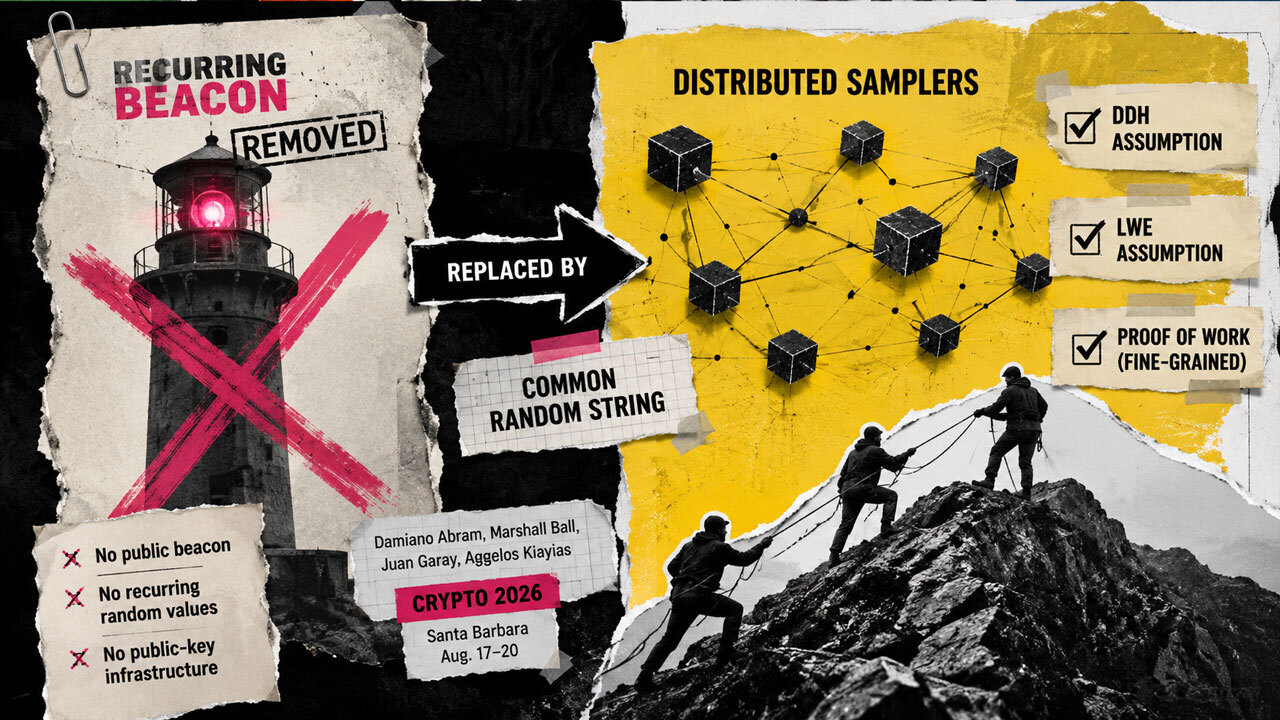
Blockchains may finally break their hidden reliance on a ticking randomness clock to keep networks secure
Summary
A Crypto 2026 paper by Damiano Abram, Marshall Ball, Juan Garay, and Aggelos Kiayias addresses permissionless consensus without assuming a known participant set or public-key infrastructure. It removes the recurring public randomness beacon used in earlier work and replaces it with d-wise independent distributed samplers plus a common random string. The construction still relies on shared setup and on DDH, LWE, and fine-grained proof-of-work assumptions. The samplers are used to support multi-verifier signatures of work, which plug into the consensus protocol. Public information does not give the protocol’s corruption threshold, network model, costs, or performance, so the result is theoretical rather than deployment-ready.